
Support
Omnichannel isn't "being present on several channels"
Omnichannel isn't "being present on several channels"
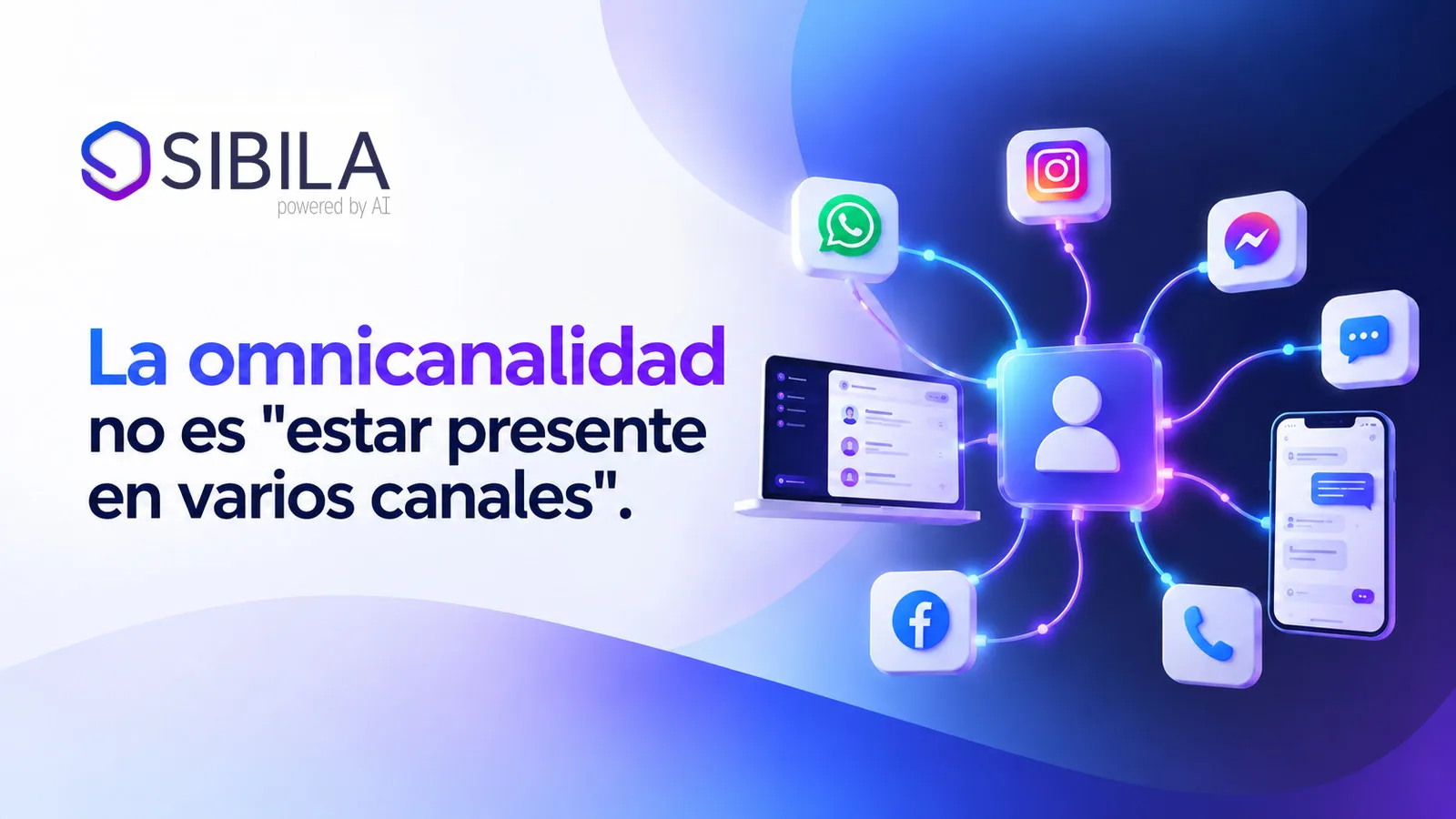
Omnichannel isn't “being present on several channels” — that's multichannel, and any company already does it without trying, with WhatsApp, Instagram, email and calls each working on its own. Real omnichannel means those channels share a single customer history, so any agent who picks up knows exactly what was discussed before, no matter where that person wrote from. This complete guide explains the difference between the two concepts, the three pillars to implement omnichannel for real, and the most common mistake that makes these projects end up creating more chaos than they had before they started.
Multichannel vs. omnichannel: the difference that defines everything else
Confusing these two terms is the most common reason an “omnichannel” project fails without anyone understanding why. Being multichannel means having a presence on several channels independently: a WhatsApp handled by one person, an Instagram checked by another, an email opened by a third — each with its own logic, with no real exchange of information between them.
Being omnichannel is structurally different: a customer who wrote on Instagram on Monday and on WhatsApp on Wednesday is, for the system and for the team, the same ongoing conversation — not two different people who happen to share a name and need someone to manually reconstruct what happened before. That difference seems subtle until you measure its real impact: when a customer has to repeat their problem because “nobody knew” they had already told it on another channel, the experience feels worse than if the company had never had several channels available in the first place.
This distinction also matters behind the scenes. A team that works multichannel (without integration) usually reports a feeling of chaos even though each channel works well on its own — because the problem isn't in any specific channel, it's in the lack of connection between them.
The three pillars to implement it without chaos
Centralize the inbox. All messages from all channels have to arrive in one place visible to the team — not in separate apps that each agent checks on their own, with their own criteria for when and how to reply. This isn't a convenience detail: it's the technical foundation without which the rest of omnichannel simply can't be sustained, no matter how good the team's intentions are.
A single customer history. Every conversation with the same lead or customer has to be linked to their profile, regardless of the channel they wrote from this time. This requires the platform to recognize the same contact across different channels —same phone number, same email, same social profile— automatically, not depend on an agent remembering it or looking it up manually across tabs.
Clear assignment rules. Who handles which conversation, so two agents don't give the same person the same reply —or a contradictory one— at the same time. Without explicit assignment rules, centralizing channels doesn't remove the confusion: it simply moves it from “several messy places” to “a single messy place”, which can be even more confusing because now all the noise is together.
The most common mistake when implementing it
The most frequent mistake, and the one that causes the most frustration after the initial investment, is adding integration tools (Zapier-style or similar) to connect platforms that weren't designed to talk to each other from the start. It works at first, because each individual connection seems simple to set up. The problem appears over time: each new flow adds one more point of failure to the whole system, and when something breaks —an automation that stops firing, data that doesn't sync— nobody on the team knows exactly why, because the system's logic is spread across several tools that no one person understands end to end.
The real alternative is to start from a platform designed for omnichannel from the beginning, not connected afterwards with successive patches. The difference isn't only technical or a matter of preference: when something fails, with a native platform there is a single place to look for the cause, while with added integrations you have to check five different systems to find where the chain broke.
What a truly omnichannel operation looks like in practice
With a platform designed for this from the ground up, WhatsApp, Instagram, Facebook, SMS and calls arrive in a single inbox, with a shared history per customer and automatic logging in the CRM — with no external flows to build, maintain or debug when something stops working. An agent who receives a new conversation can see, in the same place and without switching screens, whether that person has written before on another channel, what they were told, and where that earlier conversation ended.
Sibila centralizes WhatsApp, Instagram, Facebook, SMS, web chat and calls in a unified inbox, with native integration with Zoho CRM — every message and every call is logged automatically in the customer's history, without anyone on the team having to enter them by hand or reconcile information between different systems.
How long it really takes to implement
It depends on each company's starting point, but with a platform designed for omnichannel (and not a sum of separately built integrations), the technical setup can usually be done in under two hours. What usually takes the most time isn't the technical side — it's defining, within the team, the conversation assignment rules: who handles what, during which hours, and what happens when someone isn't available.
Signs your company is not omnichannel yet (even if you use several channels)
Before assuming you've already solved this, it's worth checking: can an agent see, without switching screens, whether a customer has already written before on another channel? Is there a single message inbox, or does each channel have its own? Is the conversation history logged automatically in the CRM, or does someone enter it by hand afterwards? If the answer to any of these is “no” or “it depends”, there's still work to do, even if the company already uses several communication channels.
What omnichannel looks like in different industries
The logic is the same in any industry, but it's worth looking at concrete examples to understand the real impact:
Retail and e-commerce: a customer asks about a product on Instagram, then writes on WhatsApp to arrange payment, and finally calls to ask about the shipping status. Without omnichannel, those are three disconnected interactions that probably three different people handled. With omnichannel, it's a single conversation with full context from the first message.
Professional services (firms, consultancies, real estate agencies): a lead fills in a web form, then writes on WhatsApp with a specific question, and finally a call is scheduled. Each of those touchpoints is linked to the same profile, so whoever takes the call already knows what was discussed earlier in writing.
Education: a prospect asks about a program on Instagram, receives information by email, and then writes on WhatsApp to clear up a question about payment. Without omnichannel, each area (marketing, admissions, administration) sees a different part of the story. With omnichannel, the whole team sees the same complete thread.
In all three cases, the problem omnichannel solves isn't “replying faster” in the abstract — it's preventing the customer from feeling they have to start from scratch every time they switch channels, something that erodes trust even when each individual reply was fast and correct.
What to look for when choosing a platform to implement omnichannel
Not every platform that calls itself “omnichannel” is omnichannel in the strict sense described in this guide. Before choosing one, it's worth checking: whether it truly unifies history per customer (not just per channel), whether the CRM integration is native or requires external connection tools, whether it allows assignment rules configurable by your own team (without depending on external technical support for every change), and whether the provider's support responds as fast as you expect your own team to respond to customers.
Frequently asked questions
Is omnichannel only for large companies? No. The problem of disconnected channels exists as soon as more than one person is handling conversations, or more than one channel is active at the same time — which happens even in small businesses with two or three people on the sales team.
Do I need to change CRM to implement omnichannel? Not necessarily. What you need is for the communication platform to integrate natively with the CRM you already use, so conversation information isn't duplicated or out of date between two systems that don't talk to each other.
How much does real omnichannel cost to implement? It varies by the platform you choose, but it's worth comparing the cost against that of maintaining several loose integrations: the ongoing maintenance of flows built with external connection tools usually ends up costing more, in time and in errors, than a native platform from the start.
Is omnichannel the same as having an AI chatbot? No. A chatbot is a tool that can coexist with an omnichannel strategy, but it doesn't replace it — you can have a chatbot connected to a single channel with no omnichannel behind it at all, and you can also be fully omnichannel without using AI at all.
What if my team is used to working channel by channel? It's the most common obstacle when implementing omnichannel, and it isn't technical but about habit. It helps to start with simple assignment rules and give an adaptation period — the initial resistance usually drops quickly once the team notices they stop losing time looking for context from earlier conversations.
Omnichannel isn't achieved by adding new channels to the list of things the team checks every morning. It's achieved by truly connecting them, with a technical foundation that supports it by design — not with patches added one by one as each new channel starts generating more noise than value.
Want to see this working with your channels?
Book a demo